
81 enchanting micro-lessons on the Tao Te Ching.
The Tao that can be spoken is not the eternal Tao.
To understand the world, one must first look within.
The best leaders are often those who remain largely unnoticed... When everything runs well, the people declare, 'We did it by ourselves.'
When Tao is abandoned, compassion and fairness arise... When the nation is in a state of disorder, faithful ministers emerge.
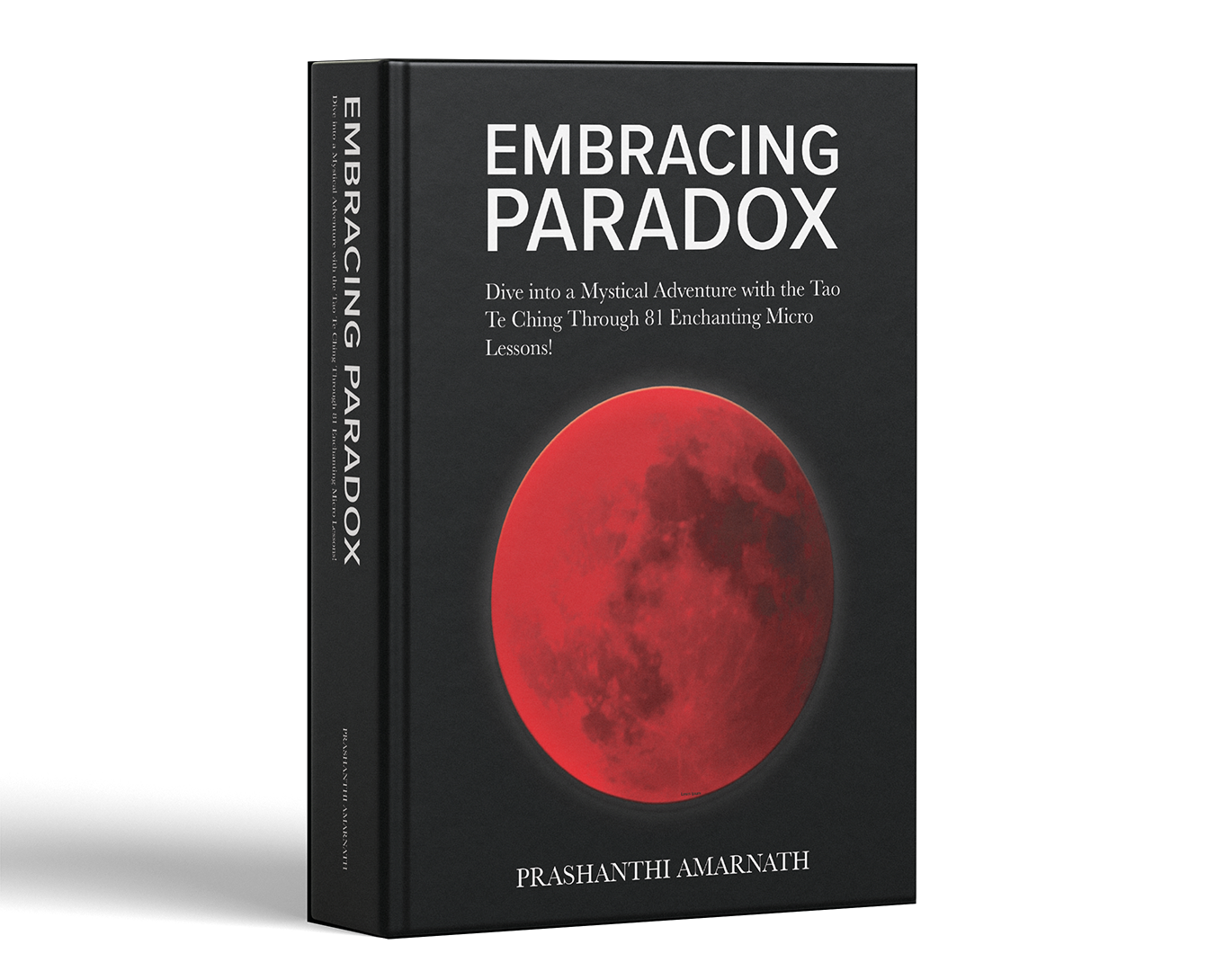
Dive into a mystical adventure
The Tao Te Ching is often treated as an ancient hurdle to clear or a complex riddle to solve. In Embracing Paradox, Prashanthi Amarnath invites you to see it differently: not as a daunting divide of language and ideas, but as a guide steering you through the winding paths of your own existence.
Through 81 enchanting micro-lessons, this book transforms ancient wisdom into a modern roadmap for handling life’s uncertainties. It is a journey that began not in a library, but in the grit of everyday life - across the landscapes of India, Australia, and the United States.

Prashanthi Amarnath - Author of Embracing Paradox
Why this book exists
Prashanthi’s intention was never to merely "translate" the Tao, but to share how it revealed itself in the lived contradictions of:
Parenting: Finding the balance between guidance and autonomy.
Leadership: Understanding the power of quiet influence and humility.
Relationships: Embracing the "dual nature" of our desires and connections.
Stillness: Discovering that "nothingness" is actually the core of everything.
"If this book helps someone breathe a little more softly, or see their contradictions as part of their wholeness rather than a flaw, then the Tao has already done its work."
When Prashanthi began writing Embracing Paradox, she didn’t set out to explain the Tao. she wanted to honor it.
The Tao Te Ching is brief, poetic, and whisper‑like in its wisdom, and Prashanthi wanted this book to carry that same spirit. Transformation rarely happens through long explanations. It often happens in a single sentence that arrives at the right moment and quietly shifts something inside.
That is why Embracing Paradox is written as 81 micro‑lessons.
Each teaching is intentionally small, simple, and spacious, something you can hold gently and return to often. The smallness leaves room for your own insight to awaken.
Because the Tao is not something you analyze.
You feel it.
You sit with it.
You allow it to unfold in its own time.
These micro‑lessons are meant to be read slowly and lived with gently. Prashanthi’s hope is that each one feels like a small doorway, a breath of stillness, or a quiet reminder that wisdom does not need to be loud to be life‑changing.
Excepts from the book
The Three Treasures
In the Tao Te Ching, Lao Tzu speaks of three treasures that guide a life lived in harmony with the Tao: Compassion, Conservation, and Humility. These are not rules to follow, but natural qualities that arise when we move with life rather than resist it. Together, they remind us that true power is gentle, true action is effortless, and true wisdom is humble.
Compassion
(Bhakti Yoga)
Devotion that opens the heart.
Seeing the same divine presence in all beings.
Love becomes the guide for action.
Conservation
(Karma Yoga)
Selfless action without excess or attachment.
Using energy, effort, and resources wisely.
Work becomes service when ego falls away.
Humility
(Jnana Yoga)
The wisdom of knowing we are not separate.
Releasing the need to dominate or be seen.
Truth reveals itself through surrender.
Key Paradoxes
Paradox is not something to solve — it’s a way of seeing.
It widens the heart. It softens the mind. It opens us to the truth that life rarely moves in straight lines
🌕 1. Softness ↔ Strength
Softness is not weakness - it is the most resilient form of power. Water is soft, yet it carves through mountains.
The Tao teaches that true strength comes from flexibility, openness, and the willingness to yield instead of force.
When we soften, we stop breaking - we begin bending.
🌖 2. Action ↔ Non‑Action (Wu Wei*)
The less we force, the more life flows.
Wu Wei doesn’t mean doing nothing - it means acting without strain, without resistance, and without ego.
Right action arises naturally when we stop pushing against reality.
🌗 3. Knowing ↔ Not Knowing
Certainty can close us; humility opens us.
The Tao reminds us that wisdom begins when we release the need to have all the answers.
Not knowing is not confusion - it is spaciousness, receptivity, and the birthplace of intuition.
🌘 4. Stillness ↔ Movement
Movement arises from stillness, and stillness is alive with movement.
The Tao shows that life is cyclical - inhale and exhale, tides rise and fall, the moon waxes and wanes.
True clarity often comes when the mind grows quiet.
🌑 5. Control ↔ Surrender
Surrender is not defeat - it is alignment.
Trying to control everything tightens us.
Letting go softens us into what is already unfolding.
Paradoxically, surrender often brings the outcome we were forcing.
🌒 6. Individuality ↔ Oneness
We are unique… and part of the same whole.
The Tao teaches that separation is an illusion created by the mind.
Recognizing oneness doesn’t erase our individuality - it brings reverence to it.
We shine more brightly when we remember we belong to everything.
🌓 7. Joy ↔ Grief
Grief is love in another form.
Opposites don’t cancel each other - they define each other.
The deeper we love, the deeper we grieve.
Holding both opens our capacity for compassion.
🌔 8. Effort ↔ Ease
Ease arises when effort becomes aligned.
When we stop pushing out of fear, effort becomes graceful.
We work with life instead of against it.
The Tao asks: Where can you soften by just 1%?
🌕 9. Light ↔ Shadow
Both are needed for wholeness.
The moon is luminous because of darkness.
Our shadows aren’t flaws - they are teachings.
They show us the places where the light is ready to enter.
*Wu Wei is often translated as effortless action. It does not mean inaction, nor does it mean indifference. Wu Wei points to action that arises naturally, without ego, strain, or the need to control outcomes. It is action that flows from alignment rather than ambition.
In this sense, Wu Wei is deeply aligned with the essence of Karma Yoga. Karma Yoga teaches us to act without attachment to results. To do our duty with sincerity, while offering the fruits of action to the Divine. The emphasis is not on what we gain, but on how we act and from where the action arises.When action is free from personal desire, fear, or recognition, it becomes pure.
This is where Wu Wei and Karma Yoga meet. Prashanthi’s Guru, Sri Sathya Sai Baba, was a perfect embodiment of this truth. Every action of his flowed effortlessly, yet was profoundly impactful. He served tirelessly, spoke when needed, remained silent when silence was required, and acted without personal motive. There was no struggle in his service, no attachment to outcomes, no sense of doership. He often reminded us,“Hands in society, head in the forest.” This is Wu Wei lived as Karma Yoga.
Podcast Features
Reach out
For podcast and speaking enquiries reach out to Prashanthi using the form below or email her on prrashanthiamarnath@gmail.com